
How could ‘Sell America’ reshape the world economy over the next few decades?

As confidence of the US’ role as the anchor of the international order weakens, our long-term Global Rebalance scenario explores how sell America could reshape the world economy over the next few decades.
Over the past year, accelerating into January, the Trump administration has taken steps that could signal a deepening turn towards US isolationism. Continued distancing from traditional multilateral frameworks, alongside a greater willingness to challenge established norms of international cooperation with allies, has fuelled concerns about the future role for the US as the anchor of international order.
For financial markets, this adds weight to a longer-run question: What happens if investors start to lose faith in the US and begin to sell America? In tandem, China has increasingly signalled its ambition for the renminbi to attain global reserve currency status – highlighting a potential shift in the balance of global financial influence.
Against this backdrop, long-run structural risks are rising. Our Megatrends Scenarios service offers a framework for quantifying these risks. In our Global Rebalance scenario we quantify how sustained shifts in policymaking from the big global powers could reshape the economic and financial order out to 2060.
In the scenario, doubt about the US role as the anchor of the international order become economically consequential. A more isolationist posture, paired with a decade of fiscal complacency and repeated political interference in Federal Reserve decision-making, steadily undermines investor confidence in US assets. Through the 2030s, policymakers delay difficult entitlement reforms, pushing government debt beyond 180% of GDP and leading investors to question debt sustainability. As concerns regarding debt and the Fed’s independence increase, risk premia rise, and capital inflows reverse. Over time, the US loses part of the “exorbitant privilege” associated with its historic dominant-currency status, and the dollar depreciates by around 20% below baseline by 2060.
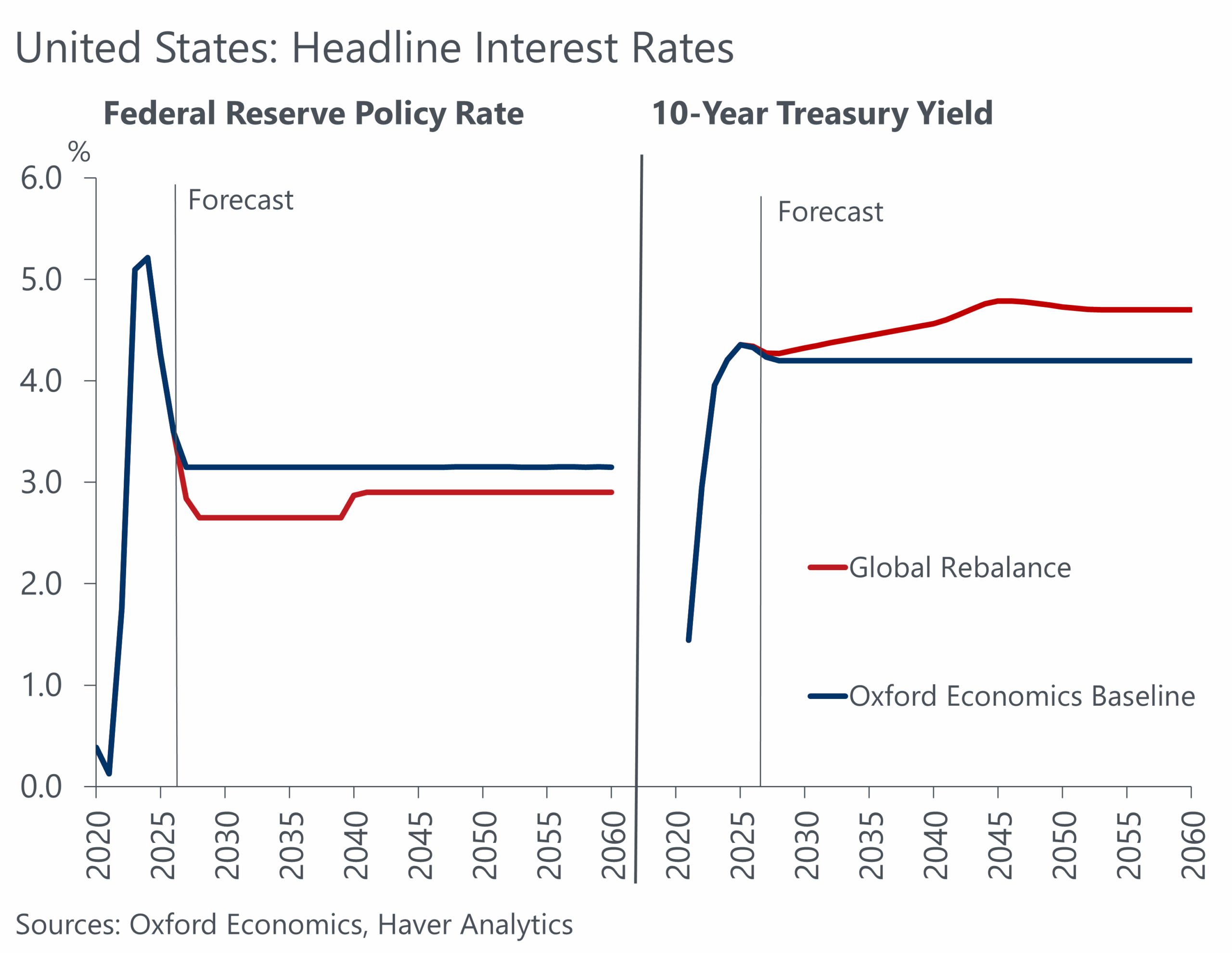
In parallel, China follows a markedly different path. Passing gradual but successful reforms, including loosening capital controls, improving bond market transparency, and widening access for foreign portfolio investors. This supports a steady rise in global confidence in renminbi assets. Pension and social security improvements also reduce the need for precautionary saving, lowering the personal savings-to-disposable-income ratio to around 10% by 2060. In turn, China becomes more aligned with advanced-economy demand structures and less dependent on investment- and export-led growth.
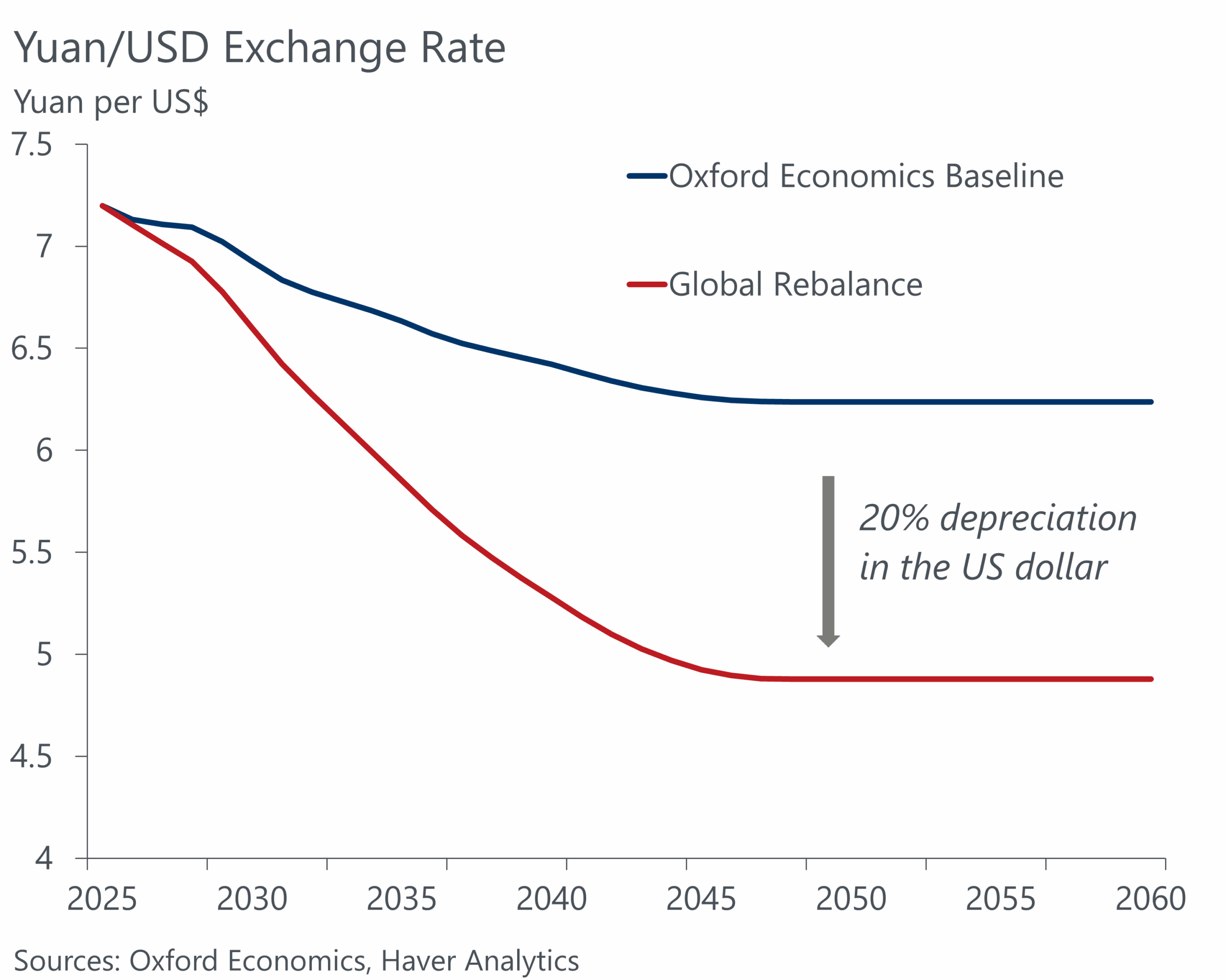
Ultimately, the outcome for the world economy is a more fragmented yet diversified global financial system. Economies that realign themselves to China’s ecosystem benefit from stronger import demand and deeper renminbi integration, while emerging markets dependent on Eurobonds gain flexibility through the ability to hedge borrowing across currencies. The Eurozone some of the fallout from US weakness is offset by stronger demand for euro-denominated assets and a larger share of global reserves.
Click this link to learn more about our Global Rebalance as part of our Megatrends Scenario service.
Tags: