
2026 Winter Olympic medals: How metals prices reshaped medal values
By Stephen Hare, Sebastien Tillett
Olympic medals symbolise sporting excellence, hard work and sacrifice, but their intrinsic value is shaped by global metals prices. Behind the podium celebrations sits a simple reality: the value of gold, silver and bronze medals rises and falls with movements in commodity markets.
Between the 2022 and 2026 Winter Olympics, metals markets have experienced one of the most pronounced repricing episodes of recent decades. Gold and silver prices have surged, corrected and surged again, while copper prices have followed a steadier upward path. Together, these moves have lifted the intrinsic value of Olympic medals to levels that would have seemed unlikely only a few years ago.
Rather than a smooth trend, this period has been shaped by repeated shifts in macroeconomic expectations, financial conditions and investor behaviour. Olympic medals in 2026 therefore provide a clear illustration of how different parts of the metals complex have repriced over a single Olympic cycle.
What are Olympic medals made of?
At the 2026 Winter Olympics, gold medals continue to be composed primarily of silver, coated with a thin layer of gold. Each gold medal contains just over 500 grams of silver and around 6 grams of gold. Silver medals contain approximately 500 grams and are made entirely of silver. Bronze medals are composed primarily of copper at 420 grams.
This composition means that changes in metals prices are the dominant driver of Olympic medal values. Design and manufacturing choices play only a minor role. Over the past four years, price movements have been unusually large for precious metals and steadily supportive for copper.
Unlock exclusive economic and business insights—sign up for our newsletter today
Medal values: From 2022 to 2026
The rise in metals prices since 2022 has translated directly into higher intrinsic Olympic medal values.
Based on prevailing prices, a gold medal at the 2026 Winter Olympics is estimated to be worth around US$1,938, almost three times its value at the previous Winter Games. Silver medals are valued at approximately US$1,003, also close to triple their 2022 level. Bronze medals remain far lower in absolute value, but their intrinsic worth has also increased steadily.
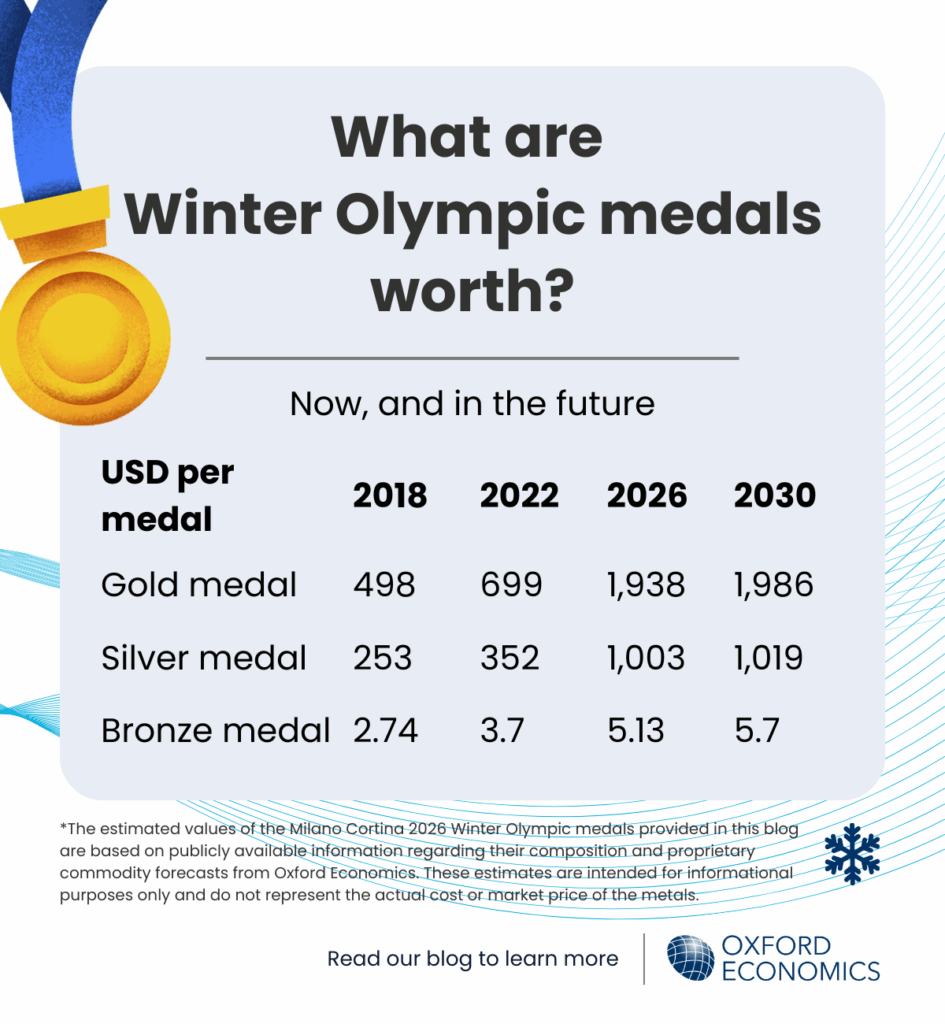
These increases mark one of the strongest four-year periods for metals prices in recent history. However, the drivers of these gains have differed across gold, silver and copper.
Why has commodity price volatility been so pronounced?
A defining feature of the past four years has been the disconnect between price action and near-term physical fundamentals, particularly for precious metals. Gold and silver prices have been driven mainly by macroeconomic repricing, shifts in financial conditions and changes in investor positioning rather than immediate supply and demand balances.
Expectations around inflation, real interest rates and the timing of US monetary easing have shifted repeatedly. Each reassessment has triggered sharp moves in precious metals prices, often amplified by speculative flows. Rapid price increases have been followed by profit-taking and corrections, reinforcing volatility.
This volatility has not been uniform across metals markets. Differences in liquidity, demand structure and sensitivity to industrial activity have produced distinct price dynamics for gold, silver and copper, with direct implications for medal values.
Gold price: Resilience anchored by structural demand
Gold prices have risen strongly since 2022, repeatedly reaching new highs despite frequent pullbacks. While short-term price movements have been volatile, the medium-term trajectory has remained underpinned by structural demand.
Safe-haven buying has been reinforced by elevated geopolitical uncertainty, policy unpredictability and concerns around fiscal sustainability in advanced economies. Periodic shifts in expectations for US interest rates have further supported gold, as investors reassess the opportunity cost of holding non-yielding assets.
Crucially, gold’s performance has not been driven solely by speculative activity. Central bank purchases have remained elevated, reflecting longer-term changes in reserve management rather than tactical responses to price movements. This demand has proven relatively insensitive to short-term volatility, helping to establish a higher and more durable price floor. ETF inflows have complemented official-sector buying, particularly during periods of heightened macroeconomic stress. Together, these forces have reduced gold’s vulnerability to sustained downside moves, even as short-term fluctuations have intensified. This helps explain why the value of gold medals in 2026 is structurally higher than in 2022.
Silver price: higher beta and sharper swings
Silver prices have increased even faster than gold over the same period, amplifying the rise in the value of silver medals. However, these gains have come with significantly greater volatility.

Silver remains closely tied to industrial demand and broader risk sentiment. Periods of macro optimism and expectations of easier financial conditions have driven powerful rallies, often reinforced by spillovers from rising gold prices. In a thinner and less liquid market, these flows have pushed silver prices well beyond near-term fundamentals.
At higher price levels, demand resistance has become more visible, particularly among industrial users. This has left silver more exposed to abrupt reversals when sentiment shifts or macro expectations are revised. As a result, silver has behaved as a higher-beta component of the precious metals complex, magnifying both upward momentum and subsequent corrections.
Despite this sensitivity, the magnitude of the repricing since 2022 has been sufficient to lift the intrinsic value of a silver medal above US$1,000 by 2026.
Bronze medals and copper prices: Steady strength with emerging constraints
Bronze medals tell a more measured story. Their value has risen steadily across Olympic cycles, increasing from US$2.74 in 2018 to US$5.13 by the 2026 Winter Games, with a further modest increase expected by 2030. Unlike precious metals, this reflects a more fundamentals-driven repricing rather than sharp swings driven by macro hedging demand.
Copper prices have strengthened alongside the broader metals complex, supported by resilient investment-led demand and tightening supply conditions. Base metals have outperformed other commodity groups as spending on electricity networks, data centres and high-value manufacturing has remained robust, even as global growth has slowed.
Supply-side constraints have reinforced this strength. Disruptions at major mines, delays to project development, permitting challenges and declining ore grades have limited supply growth, tightening refined copper balances.
However, copper’s recent gains have not been entirely smooth. Prices rose sharply into early 2026, at times moving ahead of near-term physical demand as speculative momentum built. Copper has acted as an anchor for the broader complex, with strength spilling over into other metals even as exchange inventories increased This has increased the risk of near-term consolidation. Elevated prices are beginning to constrain consumption, particularly in China. While the medium-term outlook remains supported by electrification and investment-led demand, near-term price dynamics are more vulnerable to corrections as speculative positioning unwinds.
A more measured path ahead
While the past four years have delivered exceptional gains, the pace of price growth is expected to slow in the next Olympic cycle. Much of the recent increase reflects a repricing to higher equilibrium levels rather than the start of another rapid surge.
Gold should continue to benefit from structural demand, silver is likely to remain volatile and copper prices are expected to stay cyclical but supported by fundamentals. As a result, while the intrinsic value of Olympic medals is still expected to rise modestly by the following Games, the dramatic repricing seen between 2022 and 2026 is unlikely to be repeated.
While commodity prices respond to immediate market developments, they are also shaped by interconnected forces such as global growth cycles, geopolitics, and structural shifts like the energy transition.
At Oxford Economics, we help you make sense of the commodity markets by taking the broader context into account, bringing together global commodity forecasts and market analysis to support strategic planning, procurement, and risk management. To navigate commodity price trends for 2026 and beyond, request a trial of our service.
Request a trial of our commodity serviceTags: