
Research Briefing
| Aug 15, 2022
Large European cities less exposed to inflation than other regions
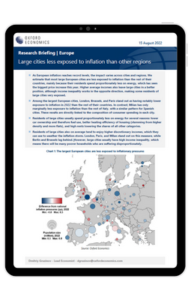 As European inflation reaches record levels, the impact varies across cities and regions. We estimate that most large European cities are less exposed to inflation than the rest of their countries, mainly because their residents spend proportionately less on energy, which has seen the biggest price increase this year. Higher average incomes also leave large cities in a better position, although income inequality works in the opposite direction, making some residents of large cities very exposed.
What you will learn:
- Among the largest European cities, London, Brussels, and Paris stand out as having notably lower exposure to inflation in 2022 than the rest of their countries.
- Residents of large cities usually spend proportionately less on energy for several reasons: lower car ownership and therefore fuel use, better heating efficiency of housing (stemming from higher density and more flats), and high rents lowering the shares of all other categories.
- Residents of large cities also on average tend to enjoy higher discretionary incomes, which they can use to weather the inflation storm. London, Paris, and Milan stand out on this measure, while Berlin and Brussels lag behind.