Global logistics challenges more than just port bottlenecks
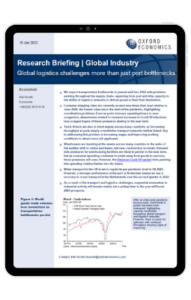
The pandemic has tested the adaptability and resilience of transport and logistics companies. With consumers focusing their spending on goods rather than on services during lockdowns, global container throughput regained its pre-pandemic level of activity relatively quickly. However, shortages across numerous dimensions—namely in labour, warehouse space, and truck trailers—have meant supply has struggled to keep pace with firm consumer demand.
We expect transportation bottlenecks to persist well into 2022 with problems existing throughout the supply chain—spanning from port and ship capacity to the ability of logistics networks to deliver goods to their final destination.
Container shipping rates are currently around nine times their level relative to June 2020, the lowest value since the start of the pandemic, highlighting coordination problems. Even as ports increase operating hours to ease congestion, absenteeism related to renewed increases in Covid-19 infections may scupper hopes of these pressures abating in the near term.
Truck drivers are also in short supply across many countries, so increasing throughput at ports simply overwhelms transport networks further inland. Key to addressing this problem is increasing wages and improving working conditions to attract more job applicants.
Warehouses are bursting at the seams across many countries in the wake of the sudden shift to online purchases, but new construction is robust. Demand-side pressures for warehousing facilities are likely to persist in the near term, but as consumer spending continues to rotate away from goods to services, these pressures will ease. However, the Omicron Covid-19 variant risks pushing this spending rotation further into the future.
What you will learn:
- What’s happening at key ports and the impact on container shipping costs
- The impact of shortages in the trucking industry and insufficient shortage space is having on the ability to get goods to customers
- When and how the bottlenecks will be unravelled