Ungated Post|24 September 2018

Investing in the skills of tomorrow; Avoiding a spiralling skills crisis
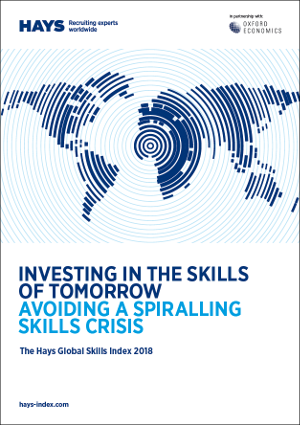
Investing in the skills of tomorrow; Avoiding a spiralling skills crisis

Attracting and retaining the right talent is crucial to an organisation’s success, wherever in the world it operates. For the seventh year running, this report––created in partnership with Hays, the global recruitment consultant––presents an exhaustive analysis of the labour market landscape in 33 countries, for the benefit of workers, firms, and policymakers.

Combining the local expertise of Hays with the analytical knowledge of Oxford Economics, the Hays Global Skills Index describes the latest shifts and trends in each labour market, and uses its unique Index to assess how easy or difficult it is for organisations to locate the skilled professionals they require.

The report also investigates the issue of slow wage growth, and related global trends such as the slowdown in productivity growth since the financial crisis. What does this mean for workforces of the future? How will they be impacted by the twin forces of globalisation and technology? Who will be the real winners and losers from the increasing adoption of automation and machine learning? We explore the wider implications of these trends for workers, and ask what this means for policymakers around the world.

Read the full report

Oxford Economics’ team is expert at applying advanced economictools that provide valuable insights into today’s most pressing business, financial,and policy issues.

To find out more about our capabilities, contact:

EMEA
Paul Donnelly
+44 (0)207 803 1416
Email

Americas
Diantha Redd
+1 (646) 503 3052
Email

Asia
Peter Suomi
+65 6829 7198
Email

  • Share:

Related Services

Socioeconomic Impact of DP World in Senegal

Socioeconomic Impact of DP World in Senegal

Oxford Economics Africa conducted a socioeconomic impact assessment of DP World Dakar covering 2022–2024. We assessed DP World’s operations in Senegal, quantifying its economic footprint, the activity supported through trade facilitation and evaluating social and environmental outcomes, while mapping how value is created for key stakeholders: employees, customers, suppliers, partners, and communities.
From Farm to Table: The Philippine Agri-Food Economy in 2025 and the Road to Competitiveness

From Farm to Table: The Philippine Agri-Food Economy in 2025 and the Road to Competitiveness

This report assesses the Philippines’ agri-food system, from agricultural production and food and beverage (F&B) manufacturing, to the wholesale, retail, and hospitality distribution networks that bring F&B to market. We quantify the economic contribution of the local agri-food sector, document the challenges faced by Philippine agri-businesses due to the tightening operating environment and shifting trade patterns, and outline a practical path to navigate these headwinds.
Economic benefits quantum computing can bring to Sussex and Greater Brighton

Economic benefits quantum computing can bring to Sussex and Greater Brighton

This report focuses on the quantum computing sector in Sussex and Greater Brighton, and its potential contribution to the South East and wider UK economy.