Research Briefing
| Mar 10, 2025
Trump’s tariffs pose uneven subnational risks across the EU
Trade tensions between the EU and the US are escalating. Aggressive protectionist policies have been a key instrument for Trump in the opening months of 2025, and the president has indicated that both blanket and sector-specific levies on EU good exports could be imposed within the coming weeks. The EU has signalled that they will retaliate in equivalent measure, but, as of time of writing, the trade policy environment remains incredibly uncertain.
What you will learn:
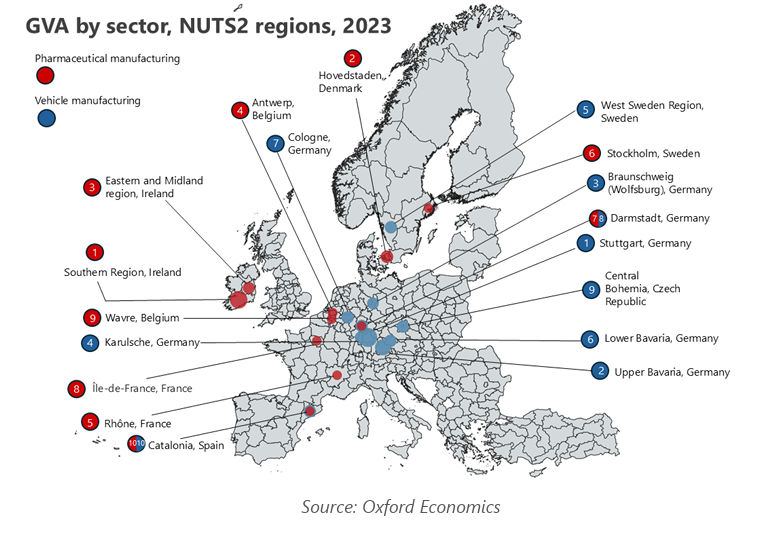
- On the surface, the potential macroeconomic impacts of tariffs are modest for the EU. However, this masks some clear sector-specific vulnerabilities. The EU’s two most valuable US goods exports, pharmaceuticals and automotives, are exposed, with Trump signalling that both sectors, along with semiconductors, may face specific levies in the region of 25%.
- Crucially, these two sectors are not uniformly dispersed within countries, meaning that the subnational impacts of tariffs could be very uneven. In particular, Ireland’s Southern Region, home to Cork, and wider Copenhagen are in the firing line for pharma tariffs, as the sector is hugely important to both economies.
- Tariffs on automotive exports present a major challenge for Germany’s economy, with the regional auto hubs of Stuttgart, Upper Bavaria, and the wider Braunschweig (including Wolfsburg) likely to suffer the most pronounced impacts. Trump’s announcement of a 25% tariff on all steel and aluminium imports to the US could also weigh heavily on these regions by disrupting supply chains and raising vehicle production costs.
- There may also be significant indirect regional impacts from tariffs. For example, car export levies could weaken activity in other subsectors that are integrated in the supply chain process, particularly in parts of central & eastern Europe (CEE) and Austria. In addition, important logistic nodes for Germany’s auto sector, such as the Port of Hamburg or Netherland’s Rotterdam, could see shipping activity adversely affected by reduced US demand.