Research Briefing
| Mar 13, 2025
Housing affordability lowest in Greek, Danish, and German cities
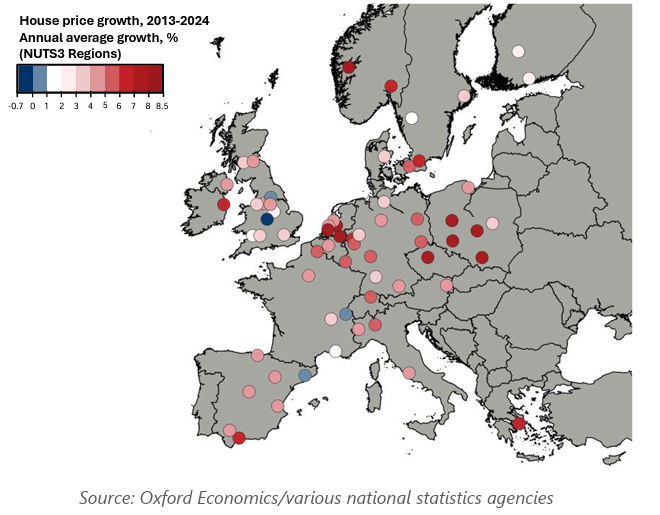
House prices across Europe have soared over the past decade, especially in cities. During this time, incomes in Europe have not kept pace with house price hikes on average, squeezing the purchasing power of homebuyers in many European cities.
What you will learn:
- Housing affordability—a measure of an individual’s ability to afford to buy or rent a property— has become increasingly worse since 2020. In most European cities, affordability improved between 2013 and 2020. But a surge in house prices after the onset of Covid-19, further compounded by rising rental prices, energy costs, and mortgage repayments for households, have weighed on overall housing affordability.
- House prices in Athens are lower than many other cities, yet housing affordability is more challenging for residents in the Greek capital than any other major city in Europe, which is in part due to Greece’s weak economic conditions over the past decade. Europe’s largest economy, Germany, has ten urban regions (NUTS2)—including Berlin and Hamburg—which are less affordable than an average European city. While the theme that cities are significantly less affordable than rural areas within a country is most pronounced in Denmark, underpinned by the second least affordable major European city—Copenhagen.
- A combination of reasonably strong demand and considerable supply-side constraints will sustain upward pressure on house prices in major European cities over the next five years. Subsequently, we expect total housing costs to continue to rise and for the current subnational disparities in affordability to persist.