
Assessing nature impacts and risks across operations and supply chains
Supporting Clyde & Co’s understanding of nature impact and risk
Our client sought to better understand how its own activities and supply chain affect nature and exposes it to risk, to inform annual reporting and long-term strategy.
Clyde & Co is a leading global law firm with over 70 offices and associated offices worldwide. As a legal services provider, its direct interaction with nature is more limited than many other sectors. Nonetheless, the firm wanted to understand how its operations and supply chain affect nature, and how changes in nature could expose it to risk.

Details
Find out how we can help you
Read MoreThe Challenge
As a legal services provider, Clyde & Co is not directly involved in the manufacture or distribution of physical goods, yet it relies on an extensive supply chain to support its activities.
Its leadership sought answers to two key questions:
- How do its operations at its office locations impact nature and expose the firm to nature-related risks?
- How does its supply chain contribute to impacts on nature, and where does the firm face vulnerabilities from changes in nature?
This evidence is valuable both for its various sustainability and annual reporting activities, as well as for informing strategy and planning processes.
As an early adopter of the Taskforce for Nature-related Financial Disclosures (TNFD), a set of recommendations to better understand a company’s interactions with nature and associated dependencies, impacts, risks, and opportunities (DIROs), Clyde & Co also required the project to break new ground in nature assessment and reporting. This meant aligning with emerging guidance while navigating an evolving landscape of sustainability-related disclosures, data availability and methodological practice.
The Solution
Our approach involved distinct components of analysis, drawing on different proprietary economic tools.
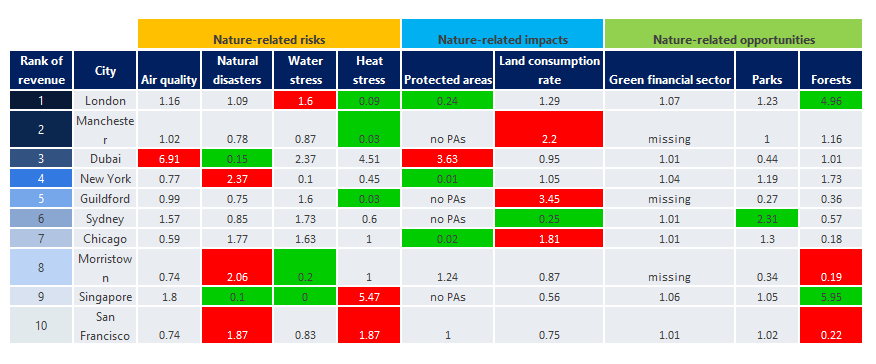
The first component assessed Clyde & Co’s offices that fall within its operational control, spanning 70 offices and associated offices across 24 countries. These offices, primarily situated in major city centres, have the potential to both impact their local environments and expose Clyde & Co to risk.
Clyde & Co office locations
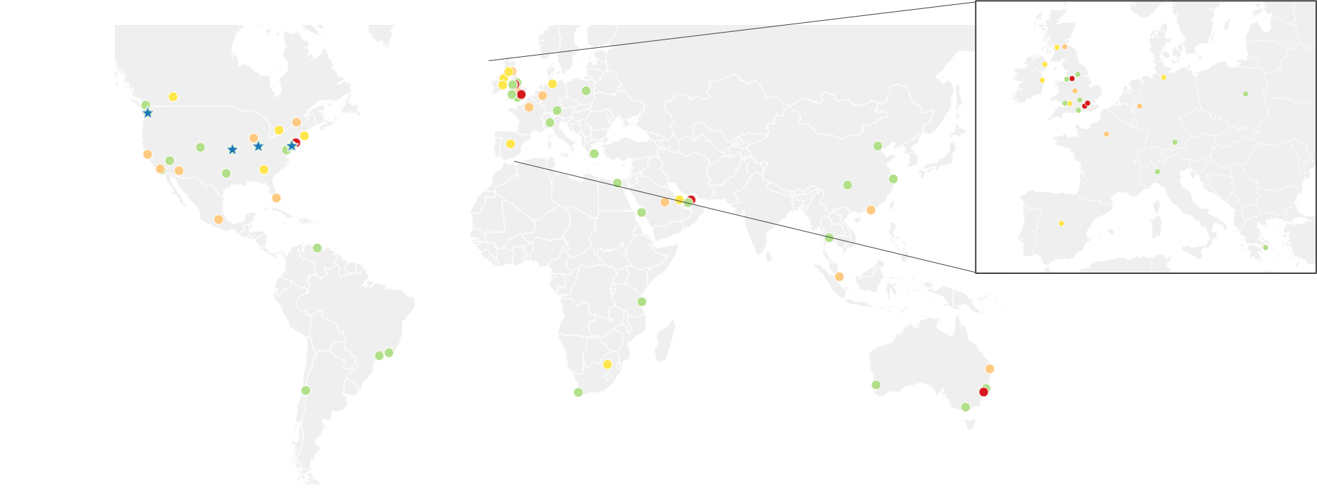
We first conducted a materiality screening considering revenue and the number of employees at each of Clyde & Co’s offices. The offices were then mapped against a range of metrics, drawing on both our proprietary Global Cities Index and external datasets. Each office was compared to other offices to test its relative performance on each indicator, which allowed us to identify relative strengths and weaknesses and highlighted priority actions.
The second component focused on Clyde & Co’s procurement activities, assessing both the impacts and risks embedded in its supply chain.
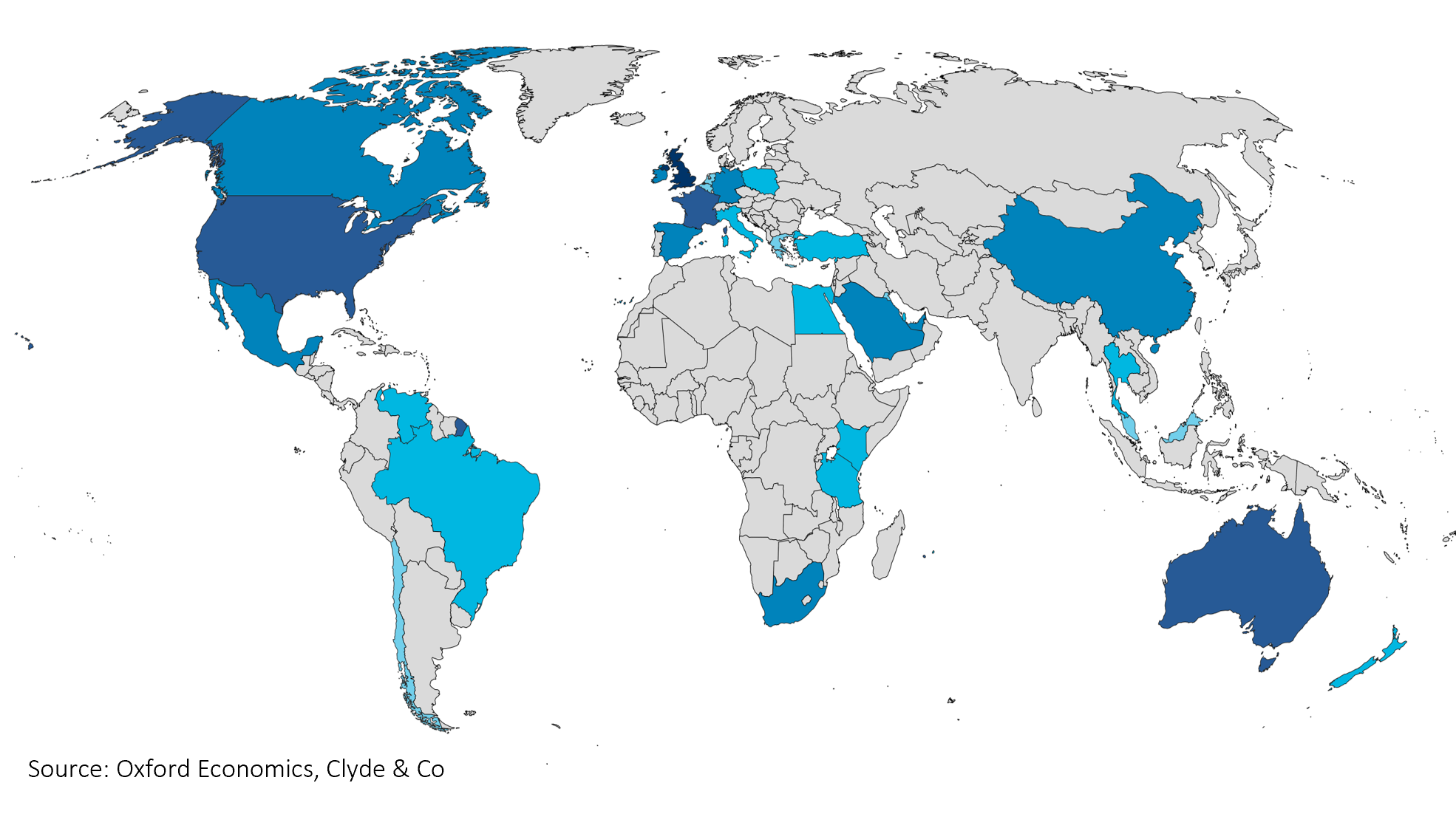
We applied our Sustainability Management Advisory Platform (S-MAP) to Clyde & Co’s data and mapped the firm’s global supply chain and conducted a materiality screening. This enabled us to quantify both the economic footprint of Clyde & Co’s procurement and its dependencies on nature and then benchmarked the results against an average company in its sector. We also conducted further analysis on selected areas of strategic interest to highlight potential exposure to risk and opportunities for action.
Clyde & Co’s procurement expenditure in 2024, by country
The Result
Clyde & Co incorporated our findings into its sustainability reporting, explicitly including nature impacts and risks for the first time and advancing its journey towards full TNFD adoption. The insights will help support supplier engagement, identify areas to investigate further, efficiently allocate resources and efforts as well as inform the planning process and target initiatives. The project also created the foundation for extended analysis and reporting in subsequent years.
Contact us to explore how we can help you
Related services

Global Sustainability Model
Accurately measure your organisation’s global footprint through economic, environmental and social lenses, identify risks and develop strategies to become more sustainable.
Economic Impact
Quantifying the economic, social, and environmental impact of government policies, new investments, technological innovations, industries, and companies at a global, national, or local level.
Global Climate Service
Assess the impact climate change will have on all facets of your business. Now and in the future.