Recognising the Critical Need for Climate Action in Italy
Leveraging the Global Climate Service scenarios to evaluate the macroeconomic implication of mitigation policies and global warming.
Download PDF

The Challenge
The macroeconomics of the clean energy transition is highly uncertain. Reaching net-zero emissions by 2050 will require a complex economic and structural transformation. Mitigating climate change will have significant consequences for growth, employment, inflation and public finances.
While global awareness of climate change is slowly increasing, there is a race against time to educate and communicate the drastic need for climate change action. The primary challenge is demonstrating to the public that while the energy transition may entail short-term economic costs due to the introduction of mitigation measures and structural changes, these can be minimised if action is taken immediately. That, in the long run, acting now entails fewer losses than inaction, demonstrating the need and urgency for intervention.
The Solution
For our client , Italian Alliance for Sustainable Development (ASviS), detailed scenario analysis was a fundamental tool for understanding and evaluating the potential consequences of decisions made today. Our Global Climate Service (GCS) provided the ideal framework to conduct an in-depth comparison of scenarios.
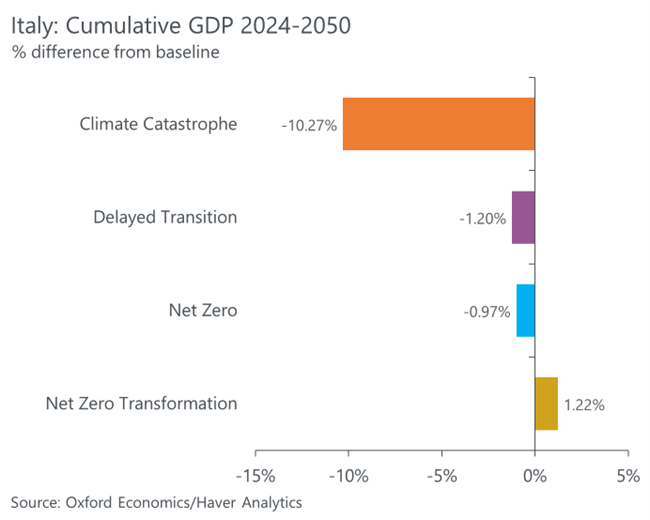
Our Net Zero and Net Zero Transformation transition scenarios were compared with the higher physical risk scenarios, Delayed Transition and Climate Catastrophe, in order to understand the consequences of climate warming under different assumptions.
- The two Net Zero scenarios assume the immediate implementation of aggressive mitigation policies, limiting global warming, and reaching net zero in 2050. In addition, the Net Zero Transformation scenario explores an upside situation thanks to measures aimed at stimulating green investments and innovation.
- Delayed Transition, on the other hand, assumes that the transition will be delayed to 2030, while Climate Catastrophe does not provide for the introduction of any mitigation measures.
The scenarios use our Global Economic Model (GEM), which delivers best in-class economic forecasts
through its ability to capture the diverse interactions among economies, energy systems, emissions and
the repercussions of economy-wide decarbonisation efforts.
Our rigorous modelling was vital to meeting ASviS’s need to focus on both the macroeconomic results,
including unemployment and GDP, and the climatic outcomes, as well as in-depth analyses of how
Italy’s government balance sheet would perform.
The Result
ASviS used the results of our scenario analysis for their annual publication “Rapporto di Primavera” to educate Italian society, economic stakeholders and institutions on the importance of immediate action against climate change.
They were able to demonstrate that “acting now” is vital to reduce the severe economic and social implications of increased global warming as the inaction would make concrete the “catastrophic” scenario, where temperatures well exceed 2°C by 2050 and where world GDP collapses.