Research Briefing
| Sep 9, 2022
A perspective on just energy transitions in Africa
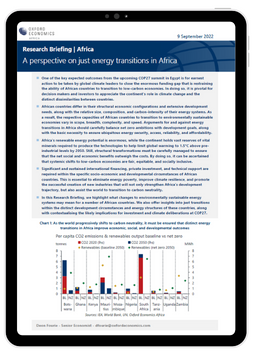
In this Research Briefing, we highlight what changes to environmentally sustainable energy systems may mean for a number of African countries. We also offer insights into just transitions within the distinct development circumstances and energy structures of these countries, along with contextualising the likely implications for investment and climate deliberations at COP27.
What you will learn:
- One of the key expected outcomes from the upcoming COP27 summit in Egypt is for earnest action to be taken by global climate leaders to close the enormous funding gap that is restraining the ability of African countries to transition to low-carbon economies. In doing so, it is pivotal for decision makers and investors to appreciate the continent’s role in climate change and the distinct dissimilarities between countries.
- African countries differ in their structural economic configurations and extensive development needs, along with the relative size, composition, and carbon-intensity of their energy systems. As a result, the respective capacities of African countries to transition to environmentally sustainable economies vary in scope, breadth, complexity, and speed. Arguments for and against energy transitions in Africa should carefully balance net zero ambitions with development goals, along with the basic necessity to ensure ubiquitous energy security, access, reliability, and affordability.
- Significant and sustained international financing, private investment, and technical support are required within the specific socio-economic and developmental circumstances of African countries. This is essential to eliminate energy poverty, improve climate resilience, and promote the successful creation of new industries that will not only strengthen Africa’s development trajectory, but also assist the world to transition to carbon neutrality.