Research Briefing | Jun 27, 2023

APAC: Financial conditions appear resilient in banking sector
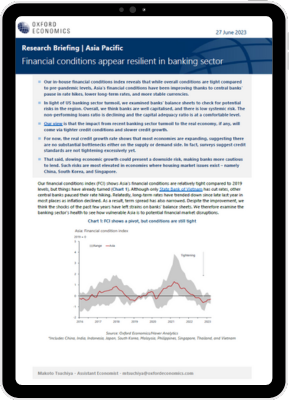
Our in-house financial conditions index reveals that while overall conditions are tight compared to pre-pandemic levels, Asia’s financial conditions have been improving thanks to central banks’ pause in rate hikes, lower long-term rates, and more stable currencies.

In light of US banking sector turmoil, we examined banks’ balance sheets to check for potential risks in the region. Overall, we think banks are well capitalised, and there is low systemic risk. The non-performing loans ratio is declining and the capital adequacy ratio is at a comfortable level.

What you will learn:

  • Our view is that the impact from recent banking sector turmoil to the real economy, if any, will come via tighter credit conditions and slower credit growth.
  • For now, the real credit growth rate shows that most economies are expanding, suggesting there are no substantial bottlenecks either on the supply or demand side. In fact, surveys suggest credit standards are not tightening excessively yet.
  • That said, slowing economic growth could present a downside risk, making banks more cautious to lend. Such risks are most elevated in economies where housing market issues exist – namely China, South Korea, and Singapore.

Tags: APAC EconomiesAsiaBanking SectorsFinancial conditionsFinancial marketsInflationMonetary policy
Back to Resource Hub

Related posts

Powering Growth: How Data Centres Are Reshaping APAC Economies

Powering Growth: How Data Centres Are Reshaping APAC Economies

At Oxford Economics, we help you surface and quantify those contributions, turning anecdotes into evidence. Our Economic Impact Consulting team builds defensible models that capture direct, indirect, and induced impacts, plus catalytic effects that are often missed, such as supplier development, skills formation, productivity gains, and infrastructure upgrades. We translate your operational data into board and regulator ready insights on jobs, GVA, incomes, and tax across construction and operations, at city, provincial, and national levels. We also run forward looking scenarios, including AI driven load growth, power and carbon forecast, and policy shifts, so you can credibly articulate both today’s impact and tomorrow’s trajectory. The result is a clear country level value story that strengthens stakeholder trust, supports siting and incentives, and helps you scale with confidence.
Shrinking supply delivery will support APAC CRE performance

Shrinking supply delivery will support APAC CRE performance

Commercial real estate development pipelines across Asia-Pacific are contracting structurally. Falling supply over the next two-three years is creating a window for operating fundamentals to improve.
APAC Key Themes 2026: Paybacks, policy offsets and trade

APAC Key Themes 2026: Paybacks, policy offsets and trade

We believe APAC will remain the strongest global performer in 2026. However, the growth trajectory will likely be more uneven than in past cycles.