Research Briefing
| Dec 13, 2022
BoK’s focus still on inflation even as growth concerns rise
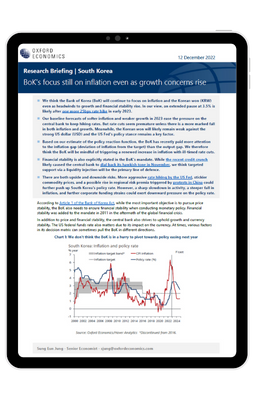
We think the Bank of Korea (BoK) will continue to focus on inflation and the Korean won (KRW) even as headwinds to growth and financial stability rise. In our view, an extended pause at 3.5% is likely after one more 25bps rate hike in early 2023.
What you will learn:
- Our baseline forecasts of softer inflation and weaker growth in 2023 ease the pressure on the central bank to keep hiking rates. But rate cuts seem premature unless there is a more marked fall in both inflation and growth. Meanwhile, the Korean won will likely remain weak against the strong US dollar (USD) and the US Fed’s policy stance remains a key factor.
- Based on our estimate of the policy reaction function, the BoK has recently paid more attention to the inflation gap (deviation of inflation from the target) than the output gap. We therefore think the BoK will be mindful of triggering a renewed increase in inflation with ill-timed rate cuts.
- There are both upside and downside risks. More aggressive rate hiking by the US Fed, stickier commodity prices, and a possible rise in regional risk premia triggered by protests in China could further push up South Korea’s policy rate. However, a sharp slowdown in activity, a steeper fall in inflation, and further corporate funding strains could exert downward pressure on the policy rate.