Research Briefing
| Sep 23, 2024
Eurozone: Why the GenAI labour market transition might not be seamless
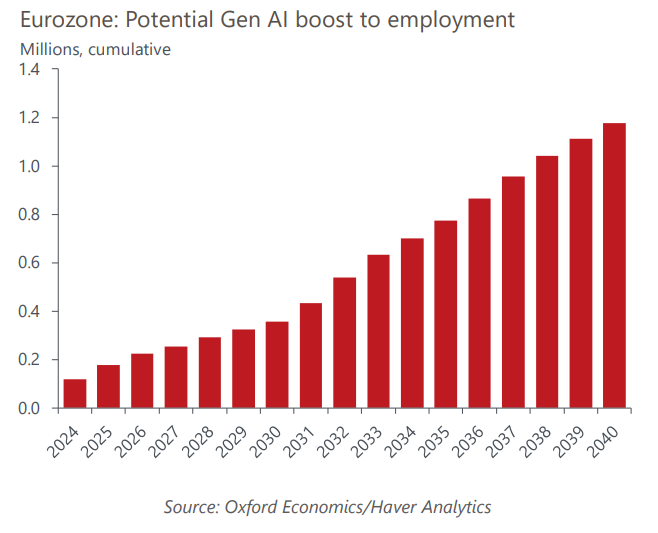
We think generative artificial intelligence could add as many as 1.2 million jobs to the eurozone labour market by 2040. But the impact will be highly uneven across roles and sectors, making government action and structural reforms keys to mitigating the downside risks.
What you will learn:
- GenAI has the potential to disrupt non-routine cognitive jobs in particular. But we think augmenting worker productivity, particularly in sectors that have struggled to translate employment gains into productivity, plus the generation of new jobs and the second-round effects for private consumption will offset the drag to employment from job elimination.
- Workers in GenAI-boosted sectors should also benefit from high labour market mobility, given the demand for transferable soft skills in highly cognitive non-routine work. But the scale of active labour market policies, which are vital in preventing temporary labour market frictions from becoming structural, varies hugely across the eurozone.
- The need to balance protecting private sector profit margins with the ethical considerations surrounding job displacement and sectoral shifts means GenAI must be at the forefront of EU industrial strategy and active labour market policy.
- In particular, Europe’s regulatory framework, underdeveloped capital markets, and weak IT investment need to be addressed to ensure effective labour market adoption of GenAI.