
Research Briefing | Aug 18, 2022

Hong Kong’s weak housing market to only get a reprieve in 2023

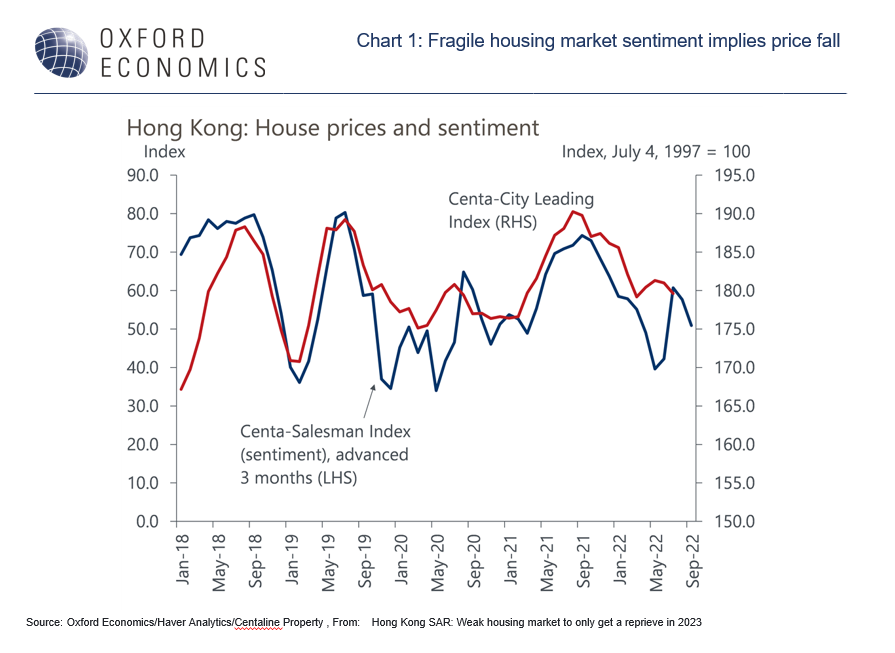
Hong Kong’s housing market sentiment weakened during H1 2022, reflecting a resurgence of Covid infections in Q1 and a weak domestic economic outlook. House prices in the secondary market fell 2.8% in Q2 versus Q4 2021. And this housing market weakness may not be over yet.

What you will learn:

  • As an international trade and financial centre in Asia, changes in Hong Kong’s external environment have an
    outsized impact on its domestic economy, and hence on its housing market.
  • We expect residential property prices to fall by about 4% y/y in Q4 2022, mainly due to the gloomy economic outlook. Slow border reopening progress and challenges to the external environment have severely dampened local sentiment.
  • Higher mortgage rates will also play a role in deterring lower income households from buying property and weigh on residential property investment demand.

Tags: Covid-19Greater ChinaHong KongHousing MarketReal Estate
Back to Resource Hub

Related posts

Takaichi’s big win doesn’t affect the fiscal outlook for Japan

Takaichi’s big win doesn’t affect the fiscal outlook for Japan

The ruling Liberal Democratic Party's (LDP) landslide election victory on Sunday doesn't change our expectation of a primary fiscal deficit of 2%-3% of GDP in FY2026-FY2028 – we still see the deficit only starting to decline from FY2029. We also keep our view that the 10-year Japanese government bond (JGB) yield will be at 2.3% at end-2026 and 2.5% at end-2027 and beyond.
India-UAE Air Travel Demand Could Go Unmet

India-UAE Air Travel Demand Could Go Unmet

Research Briefing Research finds more than a quarter of forecast demand may remain unserved without expansion, equating to 54.5M unfulfilled…
China up the value chain and deeper into export markets

China up the value chain and deeper into export markets

China’s rapid rise across both high-tech and labour-intensive exports is reshaping global trade and squeezing competitors — but which countries and industries are most at risk?