Recent Release|10 June 2022
How New Sustainability Efforts Can Boost Efficiency and Profit
Thought Leadership Team
Oxford Economics
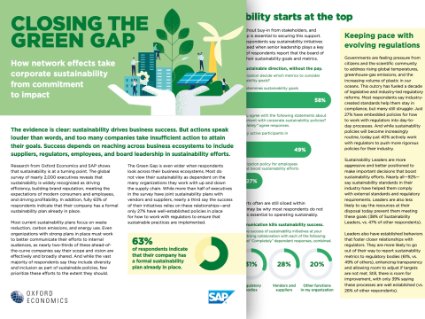
Sustainability efforts are a business necessity, but they still face headwinds, according to a new Oxford Economics and SAP study.
Oxford Economics’ Edward Cone and SAP’s Vivek Bapat discuss how organisations can better collect the right metrics, empower employees to execute on sustainability commitments, and overcome obstacles to human rights across their value chains.
Operating sustainably does not follow a one-size-fits-all model, and industries must account for the decisions that are most relevant to their field of work. Read our industry-centric Think Pieces below and find out how your industry can become more sustainable. View our industry think pieces:
The experts behind the research
Our Thought Leadership team produces original, evidence-based research made accessible to decision-makers and opinion leaders. Principals for this project included:
Edward Cone
Editorial Director, Thought Leadership
Matthew Reynolds
Senior Research Manager, Thought Leadership
Teri Robinson
Managing Editor, Thought Leadership
You might be interested in

The US is loosening restrictions on advanced chip exports to China, hoping to slow its manufacturing progress, but China’s drive for self-sufficiency is accelerating — will this policy shift actually work?

At Oxford Economics, we help you surface and quantify those contributions, turning anecdotes into evidence.
Our Economic Impact Consulting team builds defensible models that capture direct, indirect, and induced impacts, plus catalytic effects that are often missed, such as supplier development, skills formation, productivity gains, and infrastructure upgrades. We translate your operational data into board and regulator ready insights on jobs, GVA, incomes, and tax across construction and operations, at city, provincial, and national levels. We also run forward looking scenarios, including AI driven load growth, power and carbon forecast, and policy shifts, so you can credibly articulate both today’s impact and tomorrow’s trajectory.
The result is a clear country level value story that strengthens stakeholder trust, supports siting and incentives, and helps you scale with confidence.

AI-related investment is unlikely to be a near-term driver of GDP growth in the EU, unlike the US where it contributes significantly. Despite rapid expansion, the AI sector in the EU is still too small and heavily reliant on imports.

The ICT sector has been a key engine of economic growth for European cities over the last 25 years.