Research Briefing | Dec 8, 2021

A balanced path to a greener future for India
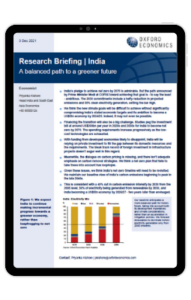
report image for a balance path to a greener future

India’s pledge to achieve net zero by 2070 is admirable. But the path announced by Prime Minister Modi at COP26 toward achieving that goal is – to say the least – ambitious. The 2030 commitments include a hefty reduction in projected emissions and 50% clean electricity generation, setting the bar high.

What you will learn from this report:

  • We think the new climate goals will be difficult to achieve without significantly compromising India’s stated economic targets and its ambition to become a US$5tn economy by 2024/25. Indeed, it may not even be possible.
  • Financing the transition will also be a big challenge. Studies peg the investment bill at around US$200bn per year in 2020s and 2030s for India to become net zero by 2070. The spending requirements increase progressively as the low-cost technologies are exhausted.
  • With funding from developed economies likely to disappoint, India will be relying on private investment to fill the gap between its domestic resources and the requirements. The bleak track record of foreign investment in infrastructure projects doesn’t augur well in this regard.

Tags: APACASEANAsiaAsia PacificAsian EconomyCoronavirusCoronavirus vaccineCovid crisisCovid restrictionsCovid19Global economicsGlobal economyGreen economyGreen energyIndiaMarketsSEASouth East AsiaVaccine programmesVaccine rolloutVaccines
Back to Resource Hub

Related Services

Powering Growth: How Data Centres Are Reshaping APAC Economies

Powering Growth: How Data Centres Are Reshaping APAC Economies

At Oxford Economics, we help you surface and quantify those contributions, turning anecdotes into evidence. Our Economic Impact Consulting team builds defensible models that capture direct, indirect, and induced impacts, plus catalytic effects that are often missed, such as supplier development, skills formation, productivity gains, and infrastructure upgrades. We translate your operational data into board and regulator ready insights on jobs, GVA, incomes, and tax across construction and operations, at city, provincial, and national levels. We also run forward looking scenarios, including AI driven load growth, power and carbon forecast, and policy shifts, so you can credibly articulate both today’s impact and tomorrow’s trajectory. The result is a clear country level value story that strengthens stakeholder trust, supports siting and incentives, and helps you scale with confidence.
Shrinking supply delivery will support APAC CRE performance

Shrinking supply delivery will support APAC CRE performance

Commercial real estate development pipelines across Asia-Pacific are contracting structurally. Falling supply over the next two-three years is creating a window for operating fundamentals to improve.