
Research Briefing | Sep 15, 2023

Is China headed for a Japanese-style balance sheet recession?
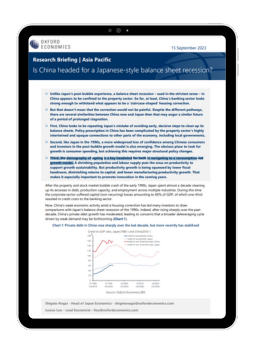
After the property and stock market bubble crash of the early 1990s, Japan spent almost a decade cleaning up its excesses in debt, production capacity, and employment across multiple industries. Now, China’s weak economic activity amid a housing correction has led many investors to draw comparisons with Japan’s balance sheet recession of the 1990s.

What you will learn:

  • Despite the different pathways, there are several similarities between China now and Japan then that may augur a similar future of a period of prolonged stagnation.
  • First, China looks to be repeating Japan’s mistake of avoiding early, decisive steps to clean up its balance sheets.
  • Second, like Japan in the 1990s, a more widespread loss of confidence among Chinese consumers and investors in the post-bubble growth model is also emerging.
  • Third, the demography of ageing is a key headwind for both in navigating to a consumption-led growth model.

Tags: APACbalance sheet recessionChinaDebtEconomic GrowthEmploymentHousing CorrectionJapanLabour SupplyMacroPropertyTechnological transfer
Back to Resource Hub

Related Posts

Takaichi’s big win doesn’t affect the fiscal outlook for Japan

Takaichi’s big win doesn’t affect the fiscal outlook for Japan

The ruling Liberal Democratic Party's (LDP) landslide election victory on Sunday doesn't change our expectation of a primary fiscal deficit of 2%-3% of GDP in FY2026-FY2028 – we still see the deficit only starting to decline from FY2029. We also keep our view that the 10-year Japanese government bond (JGB) yield will be at 2.3% at end-2026 and 2.5% at end-2027 and beyond.
India-UAE Air Travel Demand Could Go Unmet

India-UAE Air Travel Demand Could Go Unmet

Research Briefing Research finds more than a quarter of forecast demand may remain unserved without expansion, equating to 54.5M unfulfilled…
China up the value chain and deeper into export markets

China up the value chain and deeper into export markets

China’s rapid rise across both high-tech and labour-intensive exports is reshaping global trade and squeezing competitors — but which countries and industries are most at risk?