It’s a bumpy road but Australia’s 2030 climate target is within sight

Summary
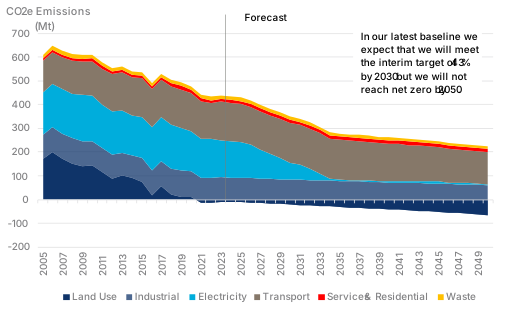
Greenhouse gas emissions in Australia are estimated to be 30% lower than they were in 2005. Our baseline forecast suggests we’re broadly on track to hit our 2030 climate target to reduce emissions by a further 13%. That said, the green transition is proving to be an uncertain and bumpy road.
There are plausible and relevant futures where the green transition is achieved ahead of schedule and temperatures increases remain well below 2 degrees, but there are also significant risks of delays which results in a significant warmer and more volatile environment in years to come. With this in mind, we applaud the recent amendment to the Australian Sustainability Reporting Standards to require businesses to describe the transition risks and opportunities for their business in a net zero future as well as the physical challenges associated with a warmer and more volatile scenario.
We’re on track to hit our 2030 targets but net zero remains aspirational.
Carbon conscious land use and renewable electricity is set to drive the green transition to 2030. But that’s when the hard work begins. The path to decarbonising transport and industry remains shrouded in uncertainty. That’s ok for now, but clarity will be required sooner rather than later to set a credible 2035 emission target and create an equitable and manageable transition to net zero by 2050.
Success over the next ten years will depend on the green electricity transition. The success of the first Capacity Investment Scheme auction, finalisation of the Victorian offshore wind power auction and AEMO’s updated Integrated Systems Plan have provided important planning clarity and support for the transition in the last six months.
Chart 1: Australia’s Greenhouse Gas Emissions Outlook
Source: DCCEEW, Oxford Economics Australia
The extent of the support provided gives a good sense of the challenges faced. Development approval delays, construction delays and cost increases are all proving to be very real and practical challenges to the energy transition. Add in the uncertainty sowed by the Coalition’s nuclear energy statements and you get a wide set of plausible forecast outcomes, with the current risks weighted towards higher levels of emissions than currently forecast.
Agriculture, forestry and land use change – the unsung hero
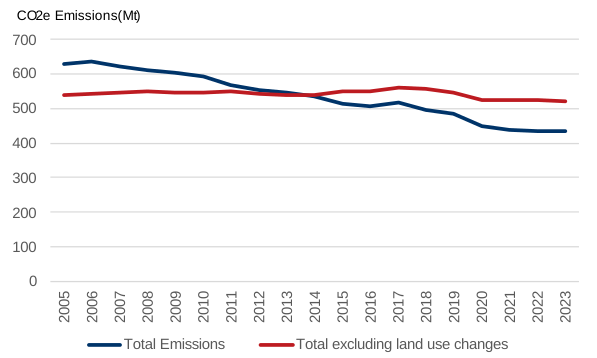
Walking the analysis back to 2005 we see that the vast majority of our success comes from change to our use of land to become significantly more environmentally conscious. More specifically, of the 181 Mt reduction in annual emissions since 2005, approximately 167Mt has been contributed by more carbon conscious land use. Once we strip this out – we see that decarbonization achieved by reducing our industrial and household use of energy is negligible since 2005.
Chart 2: A historical analysis of Australia’s greenhouse gas emissions
The baseline forecast – the mother of all scenarios
Economists have created ‘what if’ scenarios to assess the potential impact of climate change for decades. As a matter of fact, the UN IPCC collected more than 3,000 scenarios for the Sixth Assessment Report. Despite the proliferation of ‘what if’ scenarios, very few economists actually forecast the most likely future of climate emissions and its impact on the economy on a regular basis. This is what we refer to as our baseline forecast.
Our baseline forecast is based on current climate change policies implemented in Australia, an expectation that technology will continue to advance at a similar rate as we’ve seen over the last couple of decades, and the size and shape of the Australian economy in the future.
Our climate analysis is deeply integrated into our broader analysis of the Australian and global economy. The global link is important to capture the implications of the global transition to net zero and how that affects Australia’s export opportunities. The link between emissions and the rest of the economy is essential to assess the implications of climate change on factors such as employment, cost of living and investment opportunities.
Our baseline view will continually evolve as the climate transition and the economy evolves. The purpose of the baseline is to inform decision makers about the expected impact of the current emission trajectory and whether we need to do more or less to meet our targets. What’s more, the baseline can help inform what must be done to meet our targets, and what the cost of doing so will be on the broader economy.