
Research Briefing
| Oct 12, 2023
Long-term forward rates have risen too far globally
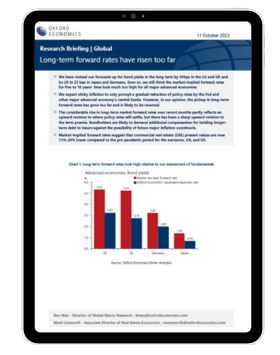
We have revised our forecasts up for bond yields in the long term by 50bps in the US and UK and by 20 to 25 bps in Japan and Germany. Even so, we still think the market-implied forward rates for five to 10 years’ time look much too high for all major advanced economies.
What you will learn:
- We expect sticky inflation to only prompt a gradual reduction of policy rates by the Fed and other major advanced economy’s central banks. However, in our opinion, the pickup in long-term forward rates has gone too far and is likely to be reversed.
- The considerable rise in long-term market forward rates over recent months partly reflects an upward revision to where policy rates will settle, but there has been a sharp upward revision to the term premia. Bondholders are likely to demand additional compensation for holding longer-term debt to insure against the possibility of future major inflation overshoots.
- Market-implied forward rates suggest that commercial real estate (CRE) present values are now 15%-20% lower compared to the pre-pandemic period for the eurozone, UK, and US.