Research Briefing
| Feb 5, 2024
Net zero poses greater risks for the South and Midwest
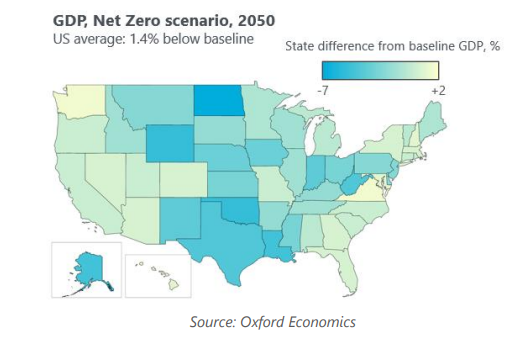
Under our latest climate scenario analysis, net zero policies in the US will have highly unequal impacts across states and metros, given the diverse nature of subnational economies. Places dependent on oil and gas activity will face the greatest challenges, followed by those with a greater reliance on manufacturing. Services-orientated states and metros will generally be most resilient. The “green” investment in the transition scenarios provides some relief and opportunities in investment-facing manufacturing subsectors, information, and professional and business services. The costs of inaction would be significant for all states and metros.
What you will learn:
- Oil and gas will be the most affected sector in our net zero scenarios due to the transition to cleaner energy sources. Consequently, states and metros highly dependent on oil and gas suffer the most severe declines in GDP relative to the baseline. Many of these areas are in the South and Southwest regions of the US. Midwest states and metros are also vulnerable in a transition due to their reliance on energy-intensive manufacturing industries. Though net zero investment provides a boost to some investment-facing sectors such as electronics, machinery, and metals.
- In contrast, services-dominated areas, particularly those with high concentrations of information and professional and business services, are among the strongest performers in a transition. This includes many states and metros in the Pacific and East regions of the US. Areas with a high presence of government services are also among the most resilient.
- The economic costs of failing to cut global carbon emissions is apparent in our Climate Catastrophe scenario. In this scenario governments fail to meet their policy pledges to transition to net zero. As a result, the US suffers from greater global warming, and more frequent and extreme climatic events. All states and metros are worse off than the baseline. States and metros in the South are particularly vulnerable due to their exposure to hurricanes, as are areas in the Southwest and Pacific due to wildfire and coastal flooding risks.