
Research Briefing
| Oct 17, 2022
Normalising auto production will mitigate downturn in Japan
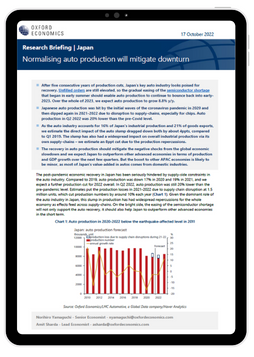
After five consecutive years of production cuts, Japan’s key auto industry looks poised for recovery. Unfilled orders are still elevated, so the gradual easing of the semiconductor shortage that began in early summer should enable auto production to continue to bounce back into early-2023. Over the whole of 2023, we expect auto production to grow 8.8% y/y.
What you will learn:
- Japanese auto production was hit by the initial waves of the coronavirus pandemic in 2020 and then dipped again in 2021-2022 due to disruption to supply-chains, especially for chips. Auto production in Q2 2022 was 20% lower than the pre-Covid level.
- As the auto industry accounts for 16% of Japan’s industrial production and 21% of goods exports, we estimate the direct impact of the auto slump dragged down both by about 4ppts, compared to Q1 2019.
- The recovery in auto production should mitigate the negative shocks from the global economic slowdown and we expect Japan to outperform other advanced economies in terms of production and GDP growth over the next few quarters.