Research Briefing | Mar 17, 2025

Opportunities in Singapore could mitigate hit from US trade barriers

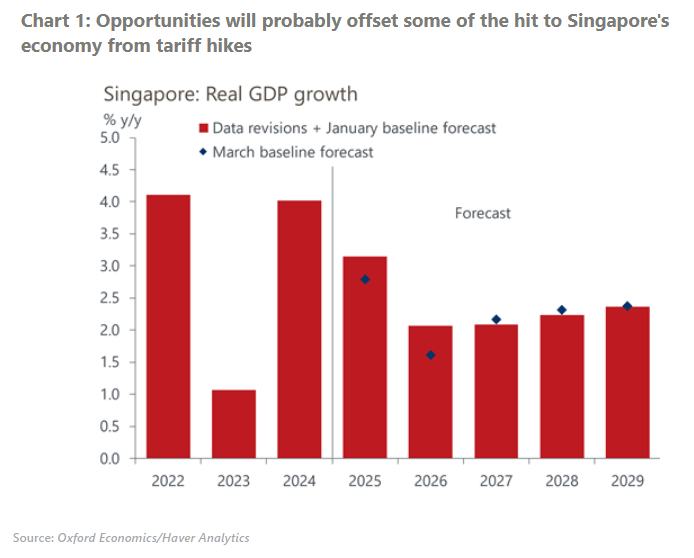
The slew of tariff proposals coming out of the US has added much uncertainty to the highly export-reliant Singapore economy. Given its status as a major shipping hub, potential gains from trade rerouting will probably offset some of the negative impacts of increased tariffs. The upshot is that although Singapore’s prospects are dimmed, they remain relatively promising.

What you will learn:

  • Singapore runs a trade deficit with the US and imposes lower tariffs on US imports due to the US-Singapore Free-Trade Agreement, meaning the threat of reciprocal tariffs is low. However, if Trump disregards the FTA, US tariffs on Singapore imports could rise to 0.71%, with specific goods like semiconductors and pharmaceuticals facing an additional 0.75%, bringing the total to 1.5%.
  • Indirect effects could pose a greater risk to Singapore, as potential tariffs may impact trade and business decisions. Second-round effects from higher tariffs on trade partners could reduce demand for goods, affecting trade flows through Singapore.
  • On the upside, the US’ competitive disadvantage in chip production may lower semiconductor tariff risks, while Singapore could benefit from trade rerouting away from China. Singapore is likely to gain US import share over the next decade as other countries lose theirs.
Tags: Asia PacificEconomic ForecastGDPGlobal tradeSingaporeUS – China trade warUS tariffs
Back to Resource Hub

Related Posts

Powering Growth: How Data Centres Are Reshaping APAC Economies

Powering Growth: How Data Centres Are Reshaping APAC Economies

At Oxford Economics, we help you surface and quantify those contributions, turning anecdotes into evidence. Our Economic Impact Consulting team builds defensible models that capture direct, indirect, and induced impacts, plus catalytic effects that are often missed, such as supplier development, skills formation, productivity gains, and infrastructure upgrades. We translate your operational data into board and regulator ready insights on jobs, GVA, incomes, and tax across construction and operations, at city, provincial, and national levels. We also run forward looking scenarios, including AI driven load growth, power and carbon forecast, and policy shifts, so you can credibly articulate both today’s impact and tomorrow’s trajectory. The result is a clear country level value story that strengthens stakeholder trust, supports siting and incentives, and helps you scale with confidence.
Shrinking supply delivery will support APAC CRE performance

Shrinking supply delivery will support APAC CRE performance

Commercial real estate development pipelines across Asia-Pacific are contracting structurally. Falling supply over the next two-three years is creating a window for operating fundamentals to improve.
APAC Key Themes 2026: Paybacks, policy offsets and trade

APAC Key Themes 2026: Paybacks, policy offsets and trade

We believe APAC will remain the strongest global performer in 2026. However, the growth trajectory will likely be more uneven than in past cycles.