
Tech is ailing; technology is doing fine


2022 was a bad year for the brand known as Tech, but a solid one for the advancement of digital technology.
Tech, the brand—the companies and culture people associate with Silicon Valley—has lost its well-curated mystique. The headlines keep coming, but too many of them are about anti-trust suits or layoffs or billionaires behaving badly, and all that is before you get to crypto. The smartest people in the room were smarter when interest rates were low. It feels like the end of an era.
Technology, though—real scientific and application development—ended the year on a high note, powered by the emergence of powerful artificial intelligence tools like ChatGPT and Dall-E 2. Known as “generative AI” because it can produce new works in writing, music, code, video, and more, this seems like a genuinely big deal with the potential to remake creative and white-collar industries. It’s also lightly regulated and, per a World Economic Forum summary, threatens “disruption of labour markets, legitimacy of scraped data, licensing, copyright and potential for biased or otherwise harmful content, misinformation, and so on.”
Better AI in areas beyond generative applications should also accelerate two technology trends we’ve been following for several years: the rise of robotics and advanced automation, and the business value of data and analytics. Heavy investment in smart automation is expected to continue across industrial sectors, increasing the competitiveness of developed economies and reshaping global supply chains.
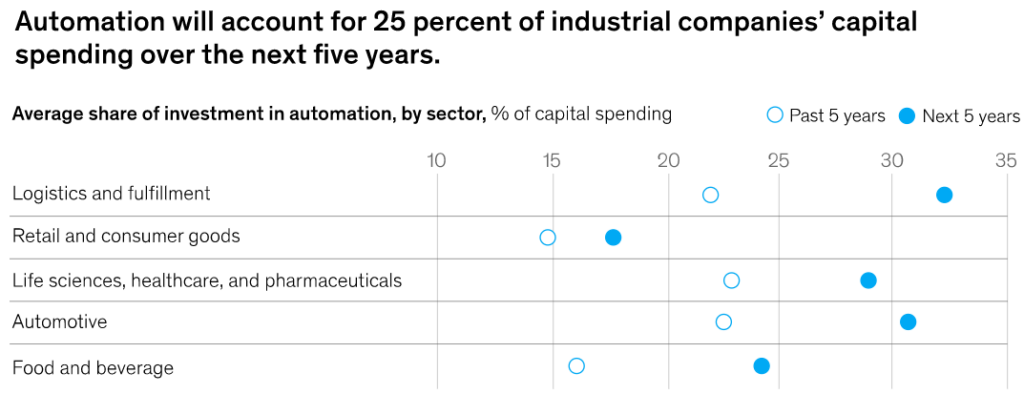
Source: McKinsey Global Industrial Robotics Survey, 65 senior leaders and executives in automotive; food and beverage; life sciences, healthcare, and pharmaceuticals; logistics and fulfillment; and retail and consumer goods sectors, August 2022
The increasing power of data, meanwhile, is driving everything from corporate sustainability efforts to public health strategy. You can’t manage what you can’t measure, and data allows measurement at unprecedented scale, with AI improving analytics and massive data flows improving AI. There are big challenges: Data collection and use is a matter of serious scrutiny from regulators in the EU and beyond, even as Apple’s data-conscious privacy features choke the flow of consumer information to some of Brand Tech’s best-known advertising businesses.
One surprising area of strength for technology is the changing landscape for talent and skills. The wave of layoffs at some of the industry’s biggest-name companies is—so far, at least—largely a correction after massive hiring during a pandemic-era boom, and some of the same firms announcing cuts are still hiring in specialties like AI. Overall US employment for IT professionals actually increased in 2022 and is projected to do so again this year as virtually all sectors of the economy remain hungry for tech skills.
All of which leads us back to the rocky patch for Brand Tech. When every company is a technology company and data is as essential as electricity—and Warren Buffet’s famous observation that industries cycle from innovators to imitators to idiots reaches its terminal phase—it’s tough to sell the old magic. Silicon Valley has become part of the mainstream economy, subject to the same gravitational forces and real-world problems as smokestack industries before it. Brand Tech will never die, and the surge in AI hype may mark the beginning of a fresh upswing, but the more businesses and economists focus on actual technology, the better.
Author

Tags: