Research Briefing
| Nov 22, 2024
The Green Leap: COP29 to reframe funding support
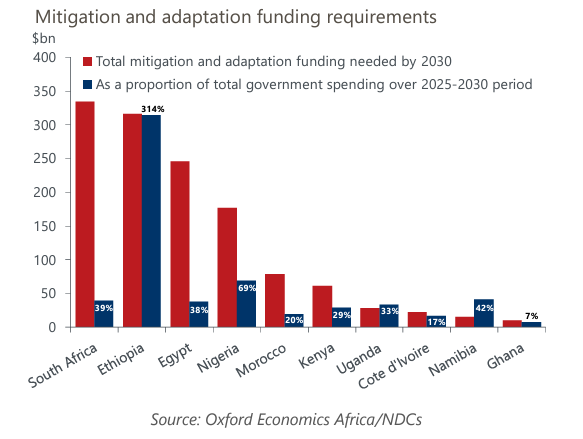
The latest nationally determined contributions (NDCs) contain astonishing funding requirements. The funding needed to adapt to climate change and mitigate carbon footprints by 2030 equates to roughly 90% of each country’s current GDP for South Africa and Nigeria, according to their NDCs. The NDCs of Ethiopia and Namibia suggest these figures are well over 100% of current GDP. COP29 should bring some clarity regarding the form and magnitude of climate-related funding. Regardless of the outcome, the fact that the lines between developmental funding and efforts to adapt to a changing climate have been blurred has transformed the funding landscape.
What you will learn:
- Advanced economies are not in a position to provide the trillions of dollars in funding required for adaptation and mitigation measures. Catalysing private capital will therefore be critical, which will require collaboration between bilateral, multilateral, and domestic authorities to provide the necessary data for risk assessments and improve their technical capabilities. Additionally, derisking projects (or reducing measurable risk through guarantees) will be a central part of the funding arsenal. Technical support is imperative to improve project and programme preparation to attract low-cost finance into bankable projects.
- Africa’s adaptation challenge is unparalleled, placing the continent at the frontline of the climate crisis. With intensifying natural disasters, escalating economic losses, and widespread vulnerability, the need for substantial funding has never been more urgent. Africa’s NDCs highlight the staggering financial requirements: South Africa’s adaptation costs are projected to exceed US$250bn through 2030 – over 70% of its current GDP.
- Mitigation funding is critical as Africa navigates its climate goals. Despite contributing roughly only 4% of global emissions, the continent’s emission-reduction targets come with hefty price tags. Ethiopia and Namibia have cited particularly high costs for emissions containment in their NDCs, reflecting not only the need to pursue environmentally friendly energy outcomes but also these countries’ electrification ambitions.