Recent Release|13 September 2016

The Longevity Economy


Economic Consulting Team
Oxford Economics
The Longevity Economy
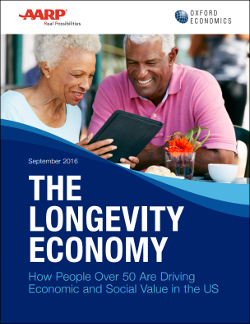
By 2015, there were more than 1.6 billion people in the world who were part of the 50-plus cohort. By 2050, this number is projected to double to nearly 3.2 billion people. Throughout the world, the growth of this age group is having a transformative impact, economically and socially.

The US alone is home to 111 million in the 50-plus cohort; they represent a powerful force that is driving economic growth and value. This is what AARP has branded the Longevity Economy, representing the sum of all economic activity driven by the needs of Americans aged 50 and older, and includes both products and services they purchase directly and the further economic activity this spending generates.

The difference it makes is substantial. In the first Longevity Economy report released in 2013 by AARP and Oxford Economics, the Longevity Economy fostered $7.1 trillion in annual economic activity. This figure has now been revised up to $7.6 trillion in the latest report. The outsized contribution reflects the changing demographics, wealth, and spending patterns of the 50-plus population as the lifespan increases and the Longevity Economy becomes more pervasive and central to economic and social policies.

About the team

Our economic consulting team are world leaders in quantitative economic analysis, working with clients around the globe and across sectors to build models, forecast markets and evaluate interventions using state-of-the art techniques. Lead consultants on this project were:


Hamilton Galloway
Hamilton Galloway

Head of Consultancy, Americas

Dan Martin
Dan Martin

Senior Economist, Economic Impact

  • Share:

Related Services

Socioeconomic Impact of DP World in Senegal

Socioeconomic Impact of DP World in Senegal

Oxford Economics Africa conducted a socioeconomic impact assessment of DP World Dakar covering 2022–2024. We assessed DP World’s operations in Senegal, quantifying its economic footprint, the activity supported through trade facilitation and evaluating social and environmental outcomes, while mapping how value is created for key stakeholders: employees, customers, suppliers, partners, and communities.
From Farm to Table: The Philippine Agri-Food Economy in 2025 and the Road to Competitiveness

From Farm to Table: The Philippine Agri-Food Economy in 2025 and the Road to Competitiveness

This report assesses the Philippines’ agri-food system, from agricultural production and food and beverage (F&B) manufacturing, to the wholesale, retail, and hospitality distribution networks that bring F&B to market. We quantify the economic contribution of the local agri-food sector, document the challenges faced by Philippine agri-businesses due to the tightening operating environment and shifting trade patterns, and outline a practical path to navigate these headwinds.
Economic benefits quantum computing can bring to Sussex and Greater Brighton

Economic benefits quantum computing can bring to Sussex and Greater Brighton

This report focuses on the quantum computing sector in Sussex and Greater Brighton, and its potential contribution to the South East and wider UK economy.