
Research Briefing | Jun 7, 2023

The unprecedented price passthrough is unsustainable in Japan
Japan: The unprecedented price passthrough is unsustainable

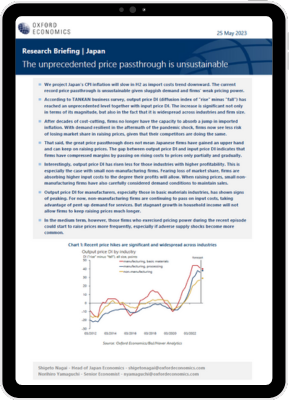
We project Japan’s CPI inflation will slow in H2 as import costs trend downward. The current record price passthrough is unsustainable given sluggish demand and firms’ weak pricing power.

What you will learn:

  • After decades of cost-cutting, firms no longer have the capacity to absorb a jump in imported inflation. With demand resilient in the aftermath of the pandemic shock, firms now see less risk of losing market share in raising prices, given that their competitors are doing the same.
  • That said, the great price passthrough does not mean Japanese firms have gained an upper hand and can keep on raising prices. The gap between output price DI and input price DI indicates that firms have compressed margins by passing on rising costs to prices only partially and gradually.
  • Output price DI for manufacturers, especially those in basic materials industries, has shown signs of peaking. For now, non-manufacturing firms are continuing to pass on input costs, taking advantage of pent-up demand for services. But stagnant growth in household income will not allow firms to keep raising prices much longer.

Tags: CPIEconomic GrowthJapanPricing Power
Back to Resource Hub

Related posts

Takaichi’s big win doesn’t affect the fiscal outlook for Japan

Takaichi’s big win doesn’t affect the fiscal outlook for Japan

The ruling Liberal Democratic Party's (LDP) landslide election victory on Sunday doesn't change our expectation of a primary fiscal deficit of 2%-3% of GDP in FY2026-FY2028 – we still see the deficit only starting to decline from FY2029. We also keep our view that the 10-year Japanese government bond (JGB) yield will be at 2.3% at end-2026 and 2.5% at end-2027 and beyond.
BoJ will need to do more because of fiscal expansion

BoJ will need to do more because of fiscal expansion

In our upcoming February forecast update, we'll stick to our expectation of a primary fiscal deficit of 2%-3% of GDP in FY2026 and FY2027, but now think it will remain at that level in FY2028, only starting to gradually decline in FY2029 and beyond.
Japan faces further BoJ rate hikes—but how much?

Japan faces further BoJ rate hikes—but how much?

The Bank of Japan (BoJ) kept its policy rate at 0.75% at its January meeting. Although our current baseline expects a final rate hike to 1% in mid-2026, the bank could move earlier if the yen weakens further.