China up the value chain and deeper into export markets
China’s growing grip on global manufacturing
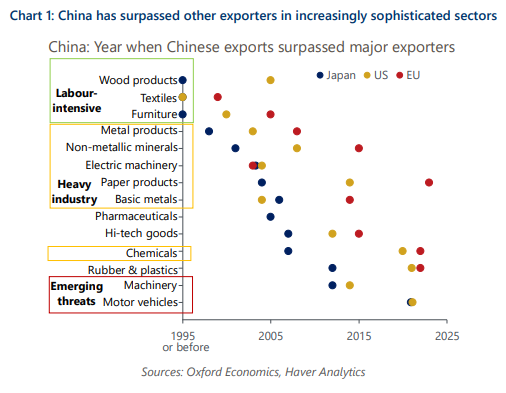
China is the largest exporter in nearly 60% of product categories in 2024, and it accounted for more than 20% of global export flows for industrial goods, up from 5% in 2001.
However, even as it has expanded into more advanced sectors, such as automotives and pharmaceuticals, China has sustained or, in some cases, even deepened its market penetration in more traditional, labour-intensive sectors, achieving dominance across a very broad base.
China’s capture of export share has typically begun in emerging economies in Southeast Asia and Latin America, before spreading to more developed regions. With the exception of the US—where tariffs have reduced direct imports from China as a share of total imports—the rise of Chinese exports in most other markets and sectors is continuing. China’s growth is likely to be the fastest in sectors such as automotives, where there is still ample room for expansion.
Among China’s competitors, losing market share has often entailed lower export volumes, especially for light industrial goods, creating zero-sum dynamics in export competition.
Domestic economic weakness, fuelled by deflation, will lead to fiercer export competition from China. China has experienced much more aggressive export price deflation than domestic deflation between 2023 and 2025, indicating that it is relying heavily on exports to offset its shortfall in domestic demand.