Research Briefing
| Mar 5, 2025
What a Russia-Ukraine ceasefire means for Europe
A ceasefire between Ukraine and Russia would provide a modest boost to EU economies, mainly due to higher military spending prompted by increased security fears and lower gas prices. But the outcome is beset by risks, particularly if the settlement is on Russia’s terms.
What you will learn:
- We have set out two scenarios for the end to hostilities: a stable ceasefire that guarantees Russia does not reinvade Ukraine, and a fragile ceasefire where Ukraine does not get reliable security guarantees. Recent events have increased the probability of a fragile ceasefire to 50% and reduced the chances of a stable resolution to just 10%. With risks of fragile scenario dominating, we caution against taking a sanguine view of the situation.
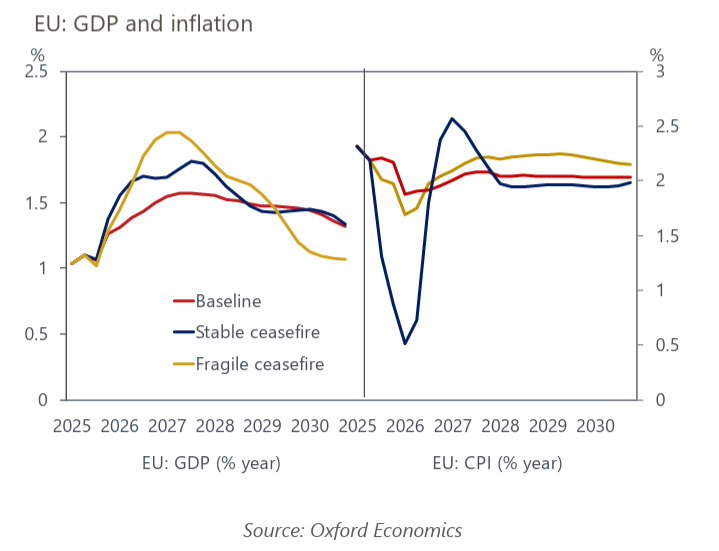
- According to our modelling, a fragile ceasefire would raise EU GDP 0.5ppts by 2030, mainly driven by a ramp-up of defence spending by all EU NATO members to 3% of GDP by 2028. These outlays would be supported by EU funding and amended fiscal rules, so countries with the most defence spending catch-up needs would benefit the most. But with sanctions on Russia continuing and a much reduced reconstruction envelope, the boost to trade would be limited.
- In a stable ceasefire scenario, the impact on headline GDP by 2030 would be similar. Notably, gas prices at pre-war values would lead to inflation dropping to 1.4% in 2026. We still expect a sizeable increase in military spending, while EU exports to Russia and Ukraine increase. Ukraine benefits from substantial reconstruction funding, but as 40% of refugees currently employed return home, EU labour supply shrinks.
- Also, in a stable ceasefire scenario we anticipate the euro appreciating by around 3% relative to the dollar. Central and Eastern European (CEE) currencies appreciate even more strongly as the geopolitical risk premium declines markedly. The decline in the geopolitical risk premium also applies also to bond yields, leading to lower yields across the CEE in the near term. In the case of a fragile ceasefire, bond yields pick up across the whole EU.