How construction companies can bridge the ‘green jobs’ gap


The construction sector will play a crucial role in Europe’s ability to meet its net zero by 2050 climate ambitions. This role includes renovating the existing building stock to reduce its carbon footprint and increase its energy efficiency, employing low carbon building strategies, technologies and materials, and recruiting, retraining and up skilling the workforce. Combining the analysis in our Global Construction Service, Global Climate Service and Industry Climate Service we anticipate that the additional construction work necessary (an estimated average of $61bn per year over 2023-2050) to meet the needs of a net zero transition will require a considerable increase in the size of the construction workforce. We refer to these additional roles as the ‘green jobs’ gap.
How can Europe bridge the ‘green jobs’ gap?
Our analysis suggests that an additional 1.7 million jobs will be needed to deliver the construction activity required to achieve net zero emissions by 2050. Current labour shortages are likely to intensify as net zero construction activity ramps up, particularly in countries like Germany where shortages threaten to become structural. Overcoming the current labour shortage challenge and bridging the green jobs gap will need to happen relatively quickly. One way to do this is through increasing female participation in the construction workforce.
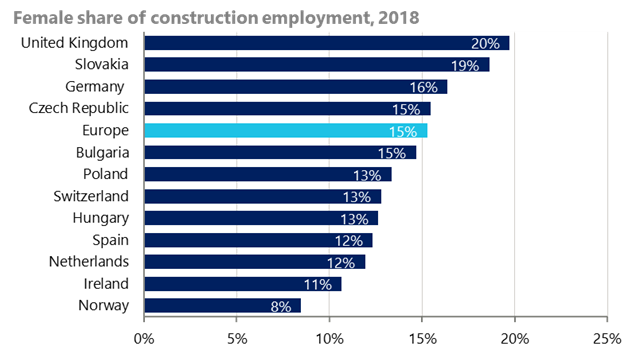
Chart 1: The UK leads Europe with around 20% of the construction workforce being women
Source: Oxford Economics, Eurostat
Females made up on average 15% of the construction workforce in Europe in 2018. This number is low but has been improving over time, albeit slowly. There has been an average annual increase in female participation of 0.25 percentage points over the last two decades across Europe. However, even if the current trend continues, women will make up only 23% of the construction labour force by 2050. There is considerable scope for improvement, and this provides an opportunity to bridge the green jobs gap relatively quickly.
If policies and initiatives could double the rate at which the gender gap is closing, this would increase the number of women in the construction workforce by 1.7 million by 2050. This is enough to bridge the green jobs gap. Importantly, employing more women does not mean displacing male workers. Even if the entire green jobs gap was met by women, the number of men employed in construction would decline by only around 3% across Europe, consistent with higher retirement rates amongst the older male workforce. The construction sector would continue to provide jobs for 10% of all employed men. Women would still make up less than a third of the European construction workforce by 2050. This is still far from gender parity but would go towards improving female representation, supporting a more gender-inclusive construction industry and would help bridge the green jobs gap.
Improving gender diversity in the construction sector will require investment from the industry and public sector to support retraining and recruitment, as well as social change to reduce some of the current cultural barriers to female participation. These shifts are already underway, and the climate benefits of increasing construction activity should provide an additional impetus to accelerate change.
Download the full research briefing to learn more.
Author


Tags: